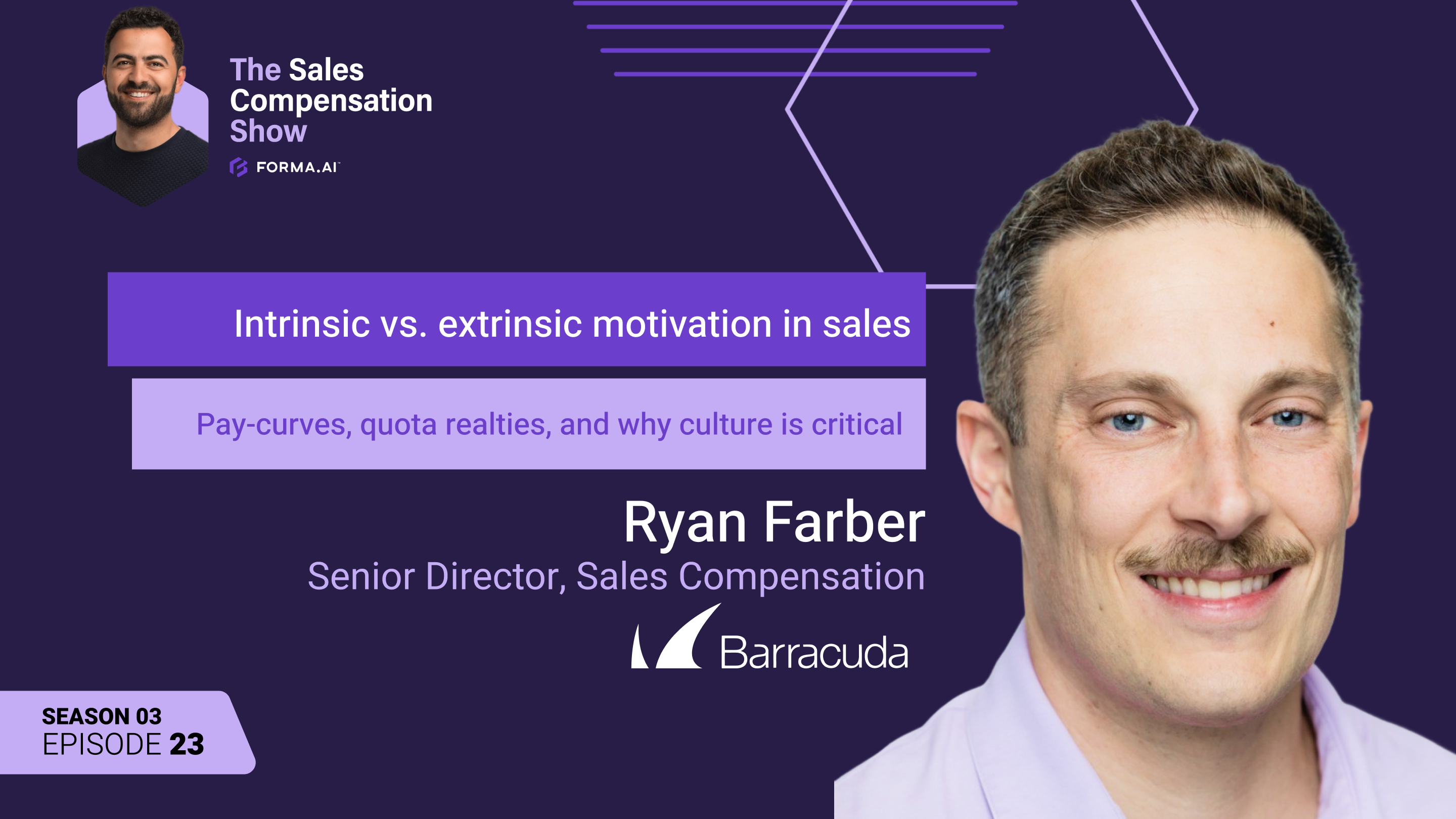
Intrinsic vs. extrinsic motivation in sales: Ryan Farber on pay curves, quotas & culture
Intrinsic vs. extrinsic motivation in sales: Ryan Farber on pay curves, quotas & culture
A practical discussion on sales incentives with Barracuda’s Ryan Farber—with practical design choices you can consider now.


Intrinsic vs. extrinsic motivation in sales: Ryan Farber on pay curves, quotas & culture
A practical discussion on sales incentives with Barracuda’s Ryan Farber—with practical design choices you can consider now.
Intrinsic vs. extrinsic motivation in sales: Ryan Farber on pay curves, quotas & culture
A practical discussion on sales incentives with Barracuda’s Ryan Farber—with practical design choices you can consider now.
Intrinsic vs. extrinsic motivation in sales: Ryan Farber on pay curves, quotas & culture
A practical discussion on sales incentives with Barracuda’s Ryan Farber—with practical design choices you can consider now.
As becomes clear to every sales compensation leader: variable pay drives performance—but it can also, unintentionally, distort it, too. Ìý
Because it's challenging to trace everything performance-related back to the plan one-to-one, combined with the very human behavioral psychology underpinning the entire dynamic, it often begs the question about which (and whether) sales incentives are working as intended.
In this episode of The Sales Compensation Show podcast, Ryan Farber, Director of Sales Compensation at Barracuda, shared his perspective, coming at it from both sides.
Certainly, incentives, used strategically and paired with strong performance management, enablement, and realistic quotas, remain one of the most practical, scalable, and reliable levers for revenue growth. But all the same, Ryan Farber and Nabeil Alazzam unpack a more contrarian take.
Their nuanced discussion surfaces where comp plans are still the most helpful—and where culture and leadership must do the heavy lifting. They also get into ways to build and balance intrinsic drive without killing results.
Watch the full episode, and check out the takeaways we've distilled below:
Episode resources
- Connect with Ryan—a founding member of our Think Tank— on
- Book:
- Also: (systems thinking, automation) Ìý
Takeaway 1: Treat incentives as a scalpel, not a steering wheel
Ryan opens with a hot take relfection and question: Ìý
“Are sales compensation plans necessary? Are they good? Are they actually driving growth?â€� Ìý
His worry is practical: “extrinsic motivation can kill intrinsic motivationâ€�—and his parenting anecdote makes this concrete. That is:Ìýif payouts become the point, how can you account for how craft and intrinsic motivation may suffer?
Nabeil brings in the operator’s lens to balance out this idea. That is, sales roles carry higher OTEs, and variable pay remains the scalable way to align upside with impact—when you use it precisely. That’s really the throughline of this conversation.
Here are some of our big takeaways:
- Pay variably only where reps have real influence—and let culture, enablement, and product do their jobs. Incentives should amplify, not steer, the whole GTM.
- Don’t outsource performance management to the plan. Ryan gets blunt here: over-reliance on the plan for performance?Ìý“That’s a really bad plan… the leadership is bad—they’re not willing to have tougher conversations.â€� Instead of overcompensating with your plan, remember that communicated standards, weekly coaching, and dignified exits are leadership's work, not the responsibility of the plan to achieve...
- Balance short‑ and long‑term rewards. Heavy short term incentives often crowd out equity for ICs. Adding longer-term incentives and ownership can signal trust and reduce churn for your best sellers.
- Intentionally frame compensation clearly in your recruiting messaging. As Ryan put it, language matters. He advocates for being more clear and broad with statements like: “we pay people for the work that they produce here� vs.“we have a good incentive plan.� This subtle language tweak sets expectations and builds trust from day one.
Overall, use incentives like a scalpel. Ensure your plan targets what reps control, pair pay with strong leadership and realistic quotas, and keep intrinsic drivers (curiosity, product mastery, customer outcomes) front and center. Which sets up the next question that came up in this discussion:
if pay is a scalpel, what shape should its edge have? Ryan offers two models—and discussed a hybrid...
Takeaway 2: choose your math—exponential vs. logarithmic pay curves (or both)
Coming at the issue from both sides, Ryan didn't just critique traditional incentives. He proposed usable models that, if applied carefully, could shape behavior well, without creating chaos.
“If you're extrinsically motivated, the ideal compensation plan would be exponential... So if your attainment was 50%, you get 25% comp… 120% attainment is 144% comp… every deal is worth more and more and more… there’s a massive massive incentive for the reps to just keep selling every time they can.�
This slope turns the next deal into the most valuable one, which pulls pipeline forward and pushes reps through walls. For this, you'd build in caps or decelerators so you don’t buy growth you can’t afford once reps rocket past plan.
Alternatively, Ryan says when you want early, consistent execution and protection from one‑off windfalls, you'd flip the logic to a logarithmic curve: Ìý
“Pay the most on the first deal and then less every one after that… after maybe that first year, the gains become much much harder… that’s maybe where you want to reward the work in sales… the company is protected… and you really just reward people who are really grinding.�
In practice, this makes the first 60–80% of attainment feel meaningful, then diminishes marginal payout as attainment rises—ideal when renewals, mega‑whales, or inherited layups can distort earnings.
As Nabeil and Ryan eventually got to, hypothetically it could even be best for most teams to land on a hybrid: using increasing marginal rewards to keep momentum. Where beyond 100%, things taper into a log‑like slope so top reps still win while finance avoids overpaying outliers. Ìý
But ultimately, as they recognized, the pre‑work is critical. You need to define what “Good� means with realistic capacity and deal‑mix math, then publish an attainment → earnings map so reps can self‑coach to the target and understand exactly where decelerators and caps kick in.
Takeaway 3: Simple ≠simplistic—make plans easy to understand and advanced in what they do
Everyone asks for “simpleâ€� compensation plans—but too often that becomes simplistic. Ryan nails the distinction: Ìý
“When you say simple, do you want the plan to just be like basic? I'll give you a flat rate, 5% commission. Like that's simple, right? But does it do something?�
Clarity matters, but sales effectiveness lives in the details. A plan that’s easy to read and engineered to shape behavior will always beat a flat 5% commission sheet. And this engineering is cross‑functional by design. As Ryan shared, you need to figure out:
“what you really want from an outcome… what the expectations are for excellence… what you expect from everybody supporting the sales team… sales ops designing the quotas, enablement helping them sell, marketing having the right message, pricing being set appropriately.â€� Ìý
Ultimately, if those links are loose, chaos follows—and the comp plan takes the blame because it’s the easiest lever to pull.
Ryan’s private‑aviation story makes the stakes obvious: Tiny operational misses shatter the experience reps are selling. Price perception compounds the issue: drop price too fast and you’re broadcasting low value; match price to the buyer’s experience and the whole thing holds together.
So what does “simple, not simplisticâ€� look like in practice? Ìý
- Focus on pushing nuance into definitions, eligibility, and data logic.
- Pick metrics by working backward from the customer moment you want—resist the flat‑rate temptation. And before you tweak rates, Ìý
- Audit the system (quota method, pricing policy, enablement) that makes the plan work.
Takeaway 4: Fix segmentation and the end‑to‑end value chain
If your plan keeps getting blamed for problems upstream, check your segmentation—then check everything it touches. The default tech taxonomy (³§²Ñµþ/²Ñ¾±»å′Ѳ¹°ù°ì±ð³Ù/·¡²Ô³Ù±ð°ù±è°ù¾±²õ±ð) feels tidy, for example, but Ryan’s seen it fail in the wild, particularly in tech. Ìý
This clip captures Ryan’s riff on this—from the taxonomy to his Ferrari analogy:
As he notes, current tech segmentation by company size doesn't account for how buyers actually buy; that’s just how to sort accounts more easily by org charts.
The fix? Segment by buying motion, not by company size. Who’s buying? Why now? Which capability actually matters to them?
The following are changes you can look to implement:
- Start with motion maps. For each ICP, define the path to value and the 1–2 moments that matter (i.e. the “Albania-region's compliance checkbox� the buyer really cares about, for example). Build demos, bundles, and SLAs around that, not a generic segment label around. the ICPs size.
- Tighten the chain. Align pricing, ops, and delivery to what sellers promise. When those links are tight, discounts shrink, margins hold, and payout curves work as intended.
- Treat quota as destiny. As Nabeil put it, “Quota setting drives 80% of the outcome of a comp plan.� Territories, coverage, and capacity must reflect your motion maps—or you’ll be tuning pay curves to solve a routing problem.
The bottom line on the debate?
Incentives aren’t a panacea, and they can be misused. But when you set realistic quotas, pick the right pay‑curve shape, and pair variable pay with strong leadership and segmentation, they’re still the most practical, scalable way to align rep behavior with company outcomes.
Listen to the full episode to hear more of Ryan and Nabeil's takes on:
- The near future—with adaptive, individualized incentives
- How to articulate or position incentives or pay within your org to align to intrinsic motivation Rewrite recruiter scripts around outcomes, not “incentives.�
- The need to audit quota methodology for capacity reality and variance by territory/motion.
Want more insights like this? Subscribe to The Sales Compensation Show on or , or for bi-weekly episodes featuring the revenue leaders behind today’s fastest-growing companies.
.png)

.avif)


